
No Clean Hands: An Indictment of the System
I. Introduction
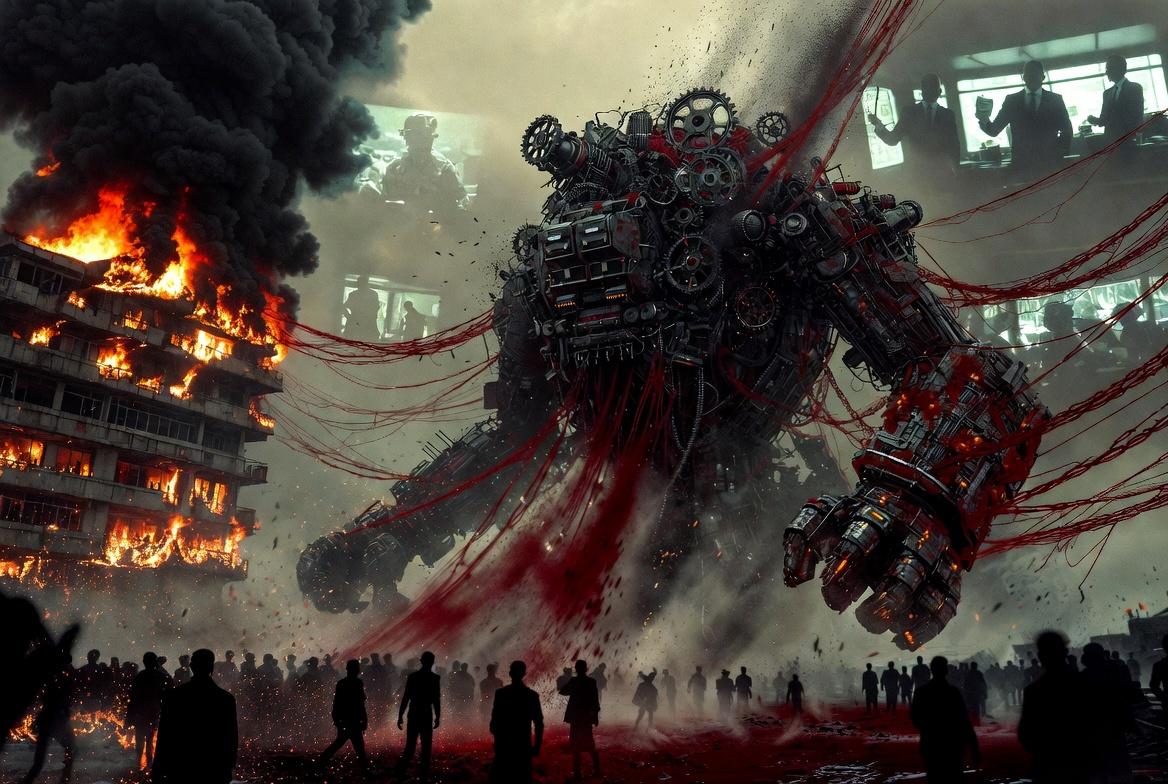
I watched people burn alive.
Not on a screen. Not in a documentary. Live. Start to finish. Real time.
A building on fire. People trapped. Smoke. Screaming. Then silence. Then nothing but the smell of death carried by a livestream that never should have existed.
That was not a war crime. That was not a military operation. That was just what humans do when the machine is allowed to run.
Since that fire, hundreds of thousands more have died. Some were soldiers. Most were not. Each one was a universe extinguished. Each one died because a system—not a person, not a country, not a single decision—keeps grinding and grinding and grinding.
This essay has no heroes. It has no villains. It has no names that will make you pick a side. Because the moment I say a name, you will stop thinking and start defending.
I will not let you do that.
I will name only the machine.
II. A Note on Method
This essay uses no names. No countries. No titles. No brands.
This is not because all actors are identical. It is because naming names triggers tribal reflexes that shut down thinking. The moment you read a name, you know whether to love or hate. You stop asking questions. You start defending.
I refuse to let you do that.
But refusing names does not mean refusing distinctions. So let me be clear about what I am not saying:
I am not saying the Western superpower and the Eurasian power are morally equivalent in every way. They are not. One launched a full-scale invasion. The other armed a proxy. Those are different acts.
I am not saying the invaded country's government is as brutal as its invader. It is not. But it is brutal enough to drag men from their homes and beat them in the streets.
I am not saying all media lies the same way. But all media lie.
I am not saying every profiteer is equally guilty. But all profit from death.
This essay is not a balance sheet. It is an indictment. It names no one so that everyone named can see themselves.
If you read this and think, "They are talking about the other side," you have missed the point.
If you read this and think, "They are talking about my side," you have begun to understand.
III. The Western Superpower
In the year 2014, a vast Western superpower decided that a corrupt but elected leader of a distant country needed to go. His crime: he was too friendly with the Eurasian power to the east.
So the superpower funded civil society groups. It trained activists. It poured money into NGOs. When the protests came—and they came because the people were genuinely angry at their corrupt leader—the superpower was there with a smile and a clipboard.
Then the leader fled. The superpower's top diplomat was caught on a leaked phone call dismissing the superpower's own allies with a vulgarity and hand-picking the next leader.
"Fuck the [allies]," she said. "This one is the guy."
That call was real. The superpower never denied it.
Within months, two things happened.
First, a network of laboratories—managed by the superpower's military, staffed by the country's scientists—expanded its presence. The superpower called it disease surveillance. The Eurasian power called it bioweapons. The full truth was never made public.
Second, energy corporations from the superpower signed billion-dollar deals to extract natural gas from a region that would soon become a war zone. The region had the third-largest shale gas reserves on the continent. The deals were signed just as the fighting began.
Coincidence? Perhaps. But the machine does not believe in coincidence.
From that moment, the superpower poured weapons into the country. Not enough to win. Just enough to keep the war going. A frozen conflict is a perfect asset: it never ends, it never escalates beyond control, and it requires constant support that flows directly to the superpower's defense contractors.
When the full-scale invasion came in 2022, those contractors rejoiced. Their stock prices soared. Their profits doubled. One of them increased artillery shell production from 14,000 to 20,000 rounds per month. Another saw a 300% profit increase. A powerful senator admitted, without shame, that the war "drove billions of dollars in investments" into the superpower's weapons industry.
The superpower's top diplomat for the region said the country could "last two more years." She said this not with sadness but with resolve. Two more years of dying. Two more years of drafting. Two more years of profit.
The superpower is the arsonist who stays to watch. Who sells tickets to the fire. Who blames the arsonist across the street while holding a lit match behind its back.
IV. The Eurasian Power
The Eurasian power to the east watched as its neighbor slipped into the Western orbit. It saw the coup. It saw the biolabs. It saw the fracking contracts. It felt encircled by the Western military alliance that had promised, decades earlier, not to move "one inch eastward."
That promise was broken. Again and again. The alliance now borders the Eurasian power directly. Missiles can reach its capital in minutes.
In 2014, the Eurasian power seized a peninsula. It armed separatists in the eastern region where the gas reserves sat. It denied doing so while doing so openly. A passenger jet was shot down over the region. Hundreds died. The Eurasian power blamed the other side.
Then, in 2022, it launched a full-scale invasion.
The leader of the Eurasian power said it was self-defense. Denazification. Demilitarization. Neutrality. But the world saw tanks crossing borders, missiles hitting apartment buildings, and cities turned to rubble.
Here is what the leader did not do: he did not decapitate the government. He could have. He chose not to. Was that restraint? Was that cruelty? It was both. Because the war continued. And continues. And will continue.
The Eurasian power's soldiers committed atrocities. This is documented. Mass graves. Filtration camps. Torture. The systematic targeting of civilians.
And here is the most damning detail:
A man from the Western superpower—a volunteer who believed in the Eurasian power's cause, who fought for it, who propagandized for it—was captured by the Eurasian power's own soldiers. They suspected him of being a spy. They put a bag over his head. They beat him. They tortured him. They killed him. Then they blew up his body in a car and burned what was left.
The leader of the Eurasian power did not order this. But he built the system where it could happen. A system where loyalty does not protect you. Where paranoia consumes its own. Where men with guns and impunity decide who lives and who dies.
When the killers were caught, a court gave them eleven years.
The man who believed in the Eurasian power was right about almost everything. He saw the Western superpower's corruption. He saw the Ukrainian government's brutality. He saw the lies of the liberal order.
And the side he chose killed him anyway.
That is the machine.
V. The Country at War
The invaded country is not innocent. No one in a war is innocent.
Its president—elected on a promise to end the war and clean up corruption—became a wartime leader. He postures on world stages. He collects standing ovations from parliaments that will never feel a missile strike. He has canceled elections and rules by decree. Martial law has no end in sight.
But the real horror is on the streets.
The country needs soldiers. Its army is exhausted. So it sends officers—called "recruiters," but they are not recruiting—to drag men from their homes. Videos show officers running over a woman with a van because she tried to stop her son from being taken. Men are beaten in the streets. Forced into vans. Sent to training camps that are not training camps. Then sent to trenches.
Five soldiers died within weeks of being mobilized from one region. The official cause for each: "hidden pathology."
Their families said they were beaten. Their families said they were murdered. Their families said the government lied.
Over six thousand complaints of draft abuse were filed with the country's own human rights office in a single year.
This is not a citizen army defending its homeland. This is a desperate government forcing its people into a meat grinder.
The defense industry in the Western superpower laughs all the way to the bank.
VI. The Profiteers
Who wins in a war?
Not the dead. Not the wounded. Not the families who wait for news that never comes.
The winners sit in boardrooms. They wear suits. They never smell smoke.
The defense contractors:
-
One company secured nearly four billion dollars in new contracts for missiles.
-
Another increased its revenue by a quarter, just from artillery shells.
-
A third saw its stock price rise every time fighting intensified.
The Western superpower's own senator said it out loud: support for the war "drove billions of dollars in investments" into the weapons industry.
He said this without irony. Without shame. Because in the machine, war is not a tragedy. It is a business model.
The Eurasian power's elite also profit. A close friend of its leader—described by the Western superpower as the leader's "personal banker"—had partial control of a company that sold rocket engines to the Western superpower's military. Even as the two powers fought by proxy in the invaded country, money flowed from the Western superpower's Pentagon to the Eurasian power's oligarch.
The Western superpower's own auditors called the deal "unallowable excessive pass-through charges" for work that was "no or negligible." But the deal continued. Because the Western superpower had no alternative supplier.
The machine feeds itself.
VII. The Political Families
The corruption goes higher.
Within months of the 2014 coup, the son of the Western superpower's second-highest official joined the board of a natural gas company in the invaded country. He had no experience in energy, no experience in Eastern Europe, no experience in corporate governance. He received between fifty and eighty thousand dollars per month.
His business partner later testified that he asked his father, the second-highest official, to disrupt an investigation into the company's corruption. The father publicly bragged about pressuring the invaded country to fire the prosecutor who was investigating.
The father said: "I told them, you're not getting the money. I'm leaving in six hours. If the prosecutor is not fired, you're not getting the money. The son of a bitch was fired."
A declassified intelligence document later revealed that the father's office had asked the intelligence agency not to disseminate a report that raised concerns about his family's business dealings in the country. Officials from the invaded country expressed "bewilderment and disappointment" at the double standard.
The Western superpower lectures the world about corruption. Its own elite families profit from the very country it claims to be saving.
VIII. The Propagandists
The media on both sides turned suffering into entertainment.
In the West, the invaded country's president became a celebrity. Late-night hosts joked with him. Magazine covers celebrated him. News segments reduced a war to a story with a hero and a villain. The hero could do no wrong. His government's brutality was ignored. His draft officers were never mentioned.
In the East, the Eurasian power's leader was framed as a father figure defending the motherland against Nazi infiltration. The dead were never shown. The mass graves were never mentioned. The torture was blamed on the other side.
Social media made it worse. The war became content. Videos of explosions set to music. TikTok battles. Algorithmic outrage. The suffering of real people reduced to entertainment for people who will never smell smoke.
The propagandists on both sides have blood on their hands. They made the war possible. They made the war popular. They made the war profitable.
IX. The Dead
Before the full-scale invasion, roughly fourteen thousand people died in the eastern region.
Since then, hundreds of thousands more have died.
Human beings. Each one a universe extinguished.
The soldier from the invaded country, dragged from his home, given a rifle he barely trained with, sent to a trench he will never leave.
The soldier from the Eurasian power, dragged from a distant village, promised a salary his family will never collect.
The child in a playground.
The old woman in a basement.
The medic reaching for a soldier already gone.
The people in the building I watched burn on a livestream that changed my life forever.
They do not care about geopolitics. They do not care about NATO or the Donbas or the rules-based order. They care that they are dead, and that the living keep finding reasons to send more of them.
X. No Clean Hands
There are no good guys in this war.
The Western superpower started it with a coup and keeps it going with weapons and profit.
The Eurasian power escalated it with an invasion and keeps it going with atrocities and lies.
The invaded country fuels it with a brutal draft and a corrupt government.
The defense contractors feed on it.
The media spins it.
The political families profit from it.
And the dead keep dying.
XI. What Would Stop the Machine?
The Western superpower would have to stop arming.
The Eurasian power would have to stop invading.
The invaded country would have to stop drafting.
The defense contractors would have to stop profiting.
The media would have to stop lying.
The political families would have to stop exploiting.
None of them will.
So the killing continues.
But you have read this. You have seen. You cannot unsee.
That is the first step toward something better. Or at least toward honesty.
I watched people burn alive. I will never forget them.
Neither should you.

 English
 Arabic
 French
 Spanish
 Portuguese
 Deutsch
 Turkish
 Dutch
Dutch
 Italiano
 Russian
 Romaian
 Portuguese (Brazil)
 Greek
Greek