
The Looksmaxxing Monster
A Taxonomy of the Manosphere Predator
Opening: The Monster
There is a monster loose on the internet. He is not hiding. He streams from his studio — a bedroom, an apartment, a rented room with a ring light and an open door. He has a following. He has a philosophy. He has a growing collection of victims.
He is young — barely out of his teens, sometimes still in them. He has no adult responsibilities. He has never been tested by a job that requires showing up on time, a relationship that requires vulnerability, a failure that hurts. He has constructed a life that requires nothing of him except performance.
He calls himself a guru. He speaks the language of "looksmaxxing" — mewing, canthal tilt, hunter eyes, bone-smashing — as if these were the only things that mattered. He is not confused. He is not misunderstood. He is not a product of his environment in any way that excuses him.
He is a fucking monster.
Let us not pretend otherwise. The behaviors described in this essay — economic entrapment, geographic isolation, chemical disinhibition, sexual assault, unlicensed medical procedures performed on camera, and the permanent monetization of a victim's humiliation — are not "alleged misbehavior." They are not "troubled young man" actions. They are not "cries for help."
They are rape. They are battery. They are crimes.
This essay describes no single individual. It is a composite built from multiple cases, multiple lawsuits, multiple investigative reports, and the observable patterns of a subculture that has produced more than one monster. The purpose is not to accuse any specific person. The purpose is to name the pattern so clearly, so brutally, that you can recognize the monster before he has a chance to hurt someone you love.
We will not use his names. Not because we are polite. Because naming elevates. Celebrity is oxygen. The pattern is the warning. The monster does not get a brand.
Part One: The Typology of the Manosphere Monster
Not everyone who enters the manosphere becomes a monster. The manosphere is a pipeline, not a destiny. But within the pipeline, there are subspecies. Understanding the taxonomy is the first step toward recognition. These types overlap. One monster can be several at once.
1. The Grifter
He does not believe the ideology. He has simply noticed that selling "hunter eyes" courses and "looksmaxxing seminars" is profitable. He privately mocks his followers. He uses the same products he sells only because they are free samples. His danger is not conviction — it is the absence of any conviction at all. He will pivot instantly when the market shifts. Today: looksmaxxing. Tomorrow: crypto. Next week: sobriety coaching. He leaves behind customers, not victims, but his indifference to harm enables the true believers who follow. The Grifter is dangerous because he legitimizes the space. He gives it a veneer of professionalism. He is the face the platform points to when asked about moderation: "He's just a businessman."
2. The True Believer
He is lost. He has internalized the blackpill so completely that he cannot see his own reflection without calipers. He spends hours measuring his canthal tilt, his jaw projection, his facial thirds. He has tried bone-smashing — hitting his own face with a hard object to stimulate bone growth. It hurt. He did it again. He has considered DIY fillers. He has read forum posts about rat poison as a joke that stopped being a joke. He is more likely to hurt himself than others — but when he turns his gaze outward, he sees collaborators, not people. If he gains any platform, he becomes dangerous because he believes. He is not performing. He is a missionary for a death cult. He will inject industrial chemicals into his own face on camera, and then he will look for someone else to inject.
3. The Spectacle Addict
This one is the most visible. He began streaming for validation. He discovered that controversy drives engagement. He injected his own face on stream (or claimed to). The audience gasped. The clips went viral. He chased that high. He needed a bigger reaction. A needle in his own cheek was old news. A needle in someone else's face — someone younger, someone who trusted him — that was the upgrade. The Spectacle Addict burns through collaborators because he burns through everything. He is an addict, and his drug is the gaze of strangers. He will escalate until he is banned, arrested, or both. He does not care which comes first. He only cares that you are watching.
4. The Failed Guru
He once had a following. He sold a course. The course was exposed as a scam. He lost subscribers, then income, then his apartment. He moved back into a smaller space — or couch-surfed, or found a cheap room where no one asks questions. He is furious. The world owes him. Women owe him. The platforms owe him. He radicalizes not from belief but from bitterness. He is the most likely to commit violence because he has nothing left to lose. His audience has shrunk, but his need for attention has not. He will do worse things to get back what he lost. The line between bitter failure and violent monster is thinner than anyone wants to admit.
5. The Rebranding Artist
This is the most slippery. He is always in transition. Today: looksmaxxing guru. Tomorrow: recovery influencer. Next week: Christian masculinity coach. He treats identity as a content vertical. He is not lying, exactly — he believes each new self in the moment he inhabits it. But he has no stable self to return to. Exposure does not defeat him. It just forces a rebrand. He is dangerous because he is adaptive. He evolves faster than moderation. By the time the platform bans his old handle, he has already launched a new one. By the time the media reports on his victims, he has already framed himself as the victim — of addiction, of mental illness, of a "cancel culture" that just doesn't understand.
6. The Criminal
This is not a separate subspecies. This is the overlap of the previous five when the behavior crosses into felony. The Grifter who commits fraud. The Spectacle Addict who commits battery. The Failed Guru who commits sexual assault. The Rebranding Artist who continues to monetize a victim's likeness. The True Believer who injects a minor with methamphetamine because he genuinely thinks he is helping.
The monster is all of these at once, or none of them. Typologies are maps, not cages. But the map helps. When you see a young man offering to "fix" someone's face on livestream, you can now ask: which subspecies is this? And what do I do about it?
Part Two: The Architecture of the Hunting Ground
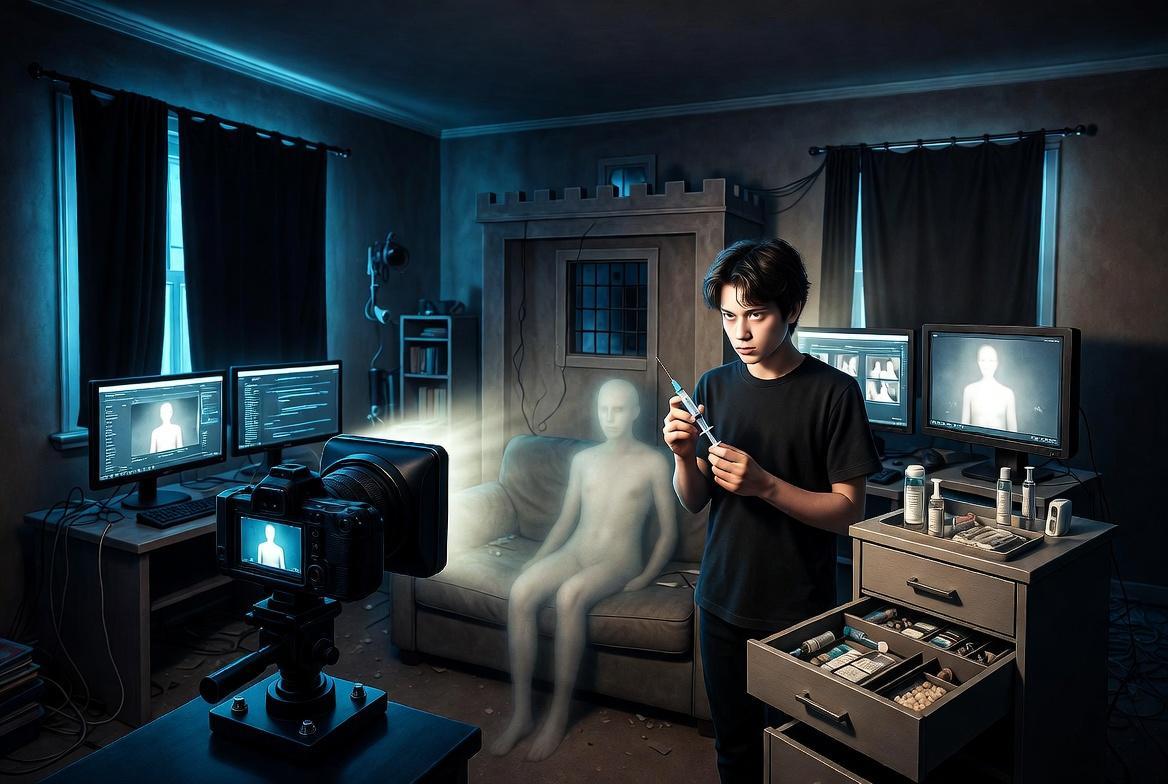
The monster needs a private space where he controls all variables. This is his hunting ground. It might be an apartment he rents with streaming revenue. It might be a studio with blackout curtains and a camera mount bolted to the wall. It might be a hotel room. It might be a shared house where roommates have learned not to ask questions. The address does not matter. What matters is that he is the king of that space, and anyone he brings there is a guest in his kingdom — subject to his rules, his schedule, his whims.
Why private space is essential. He cannot control a victim on neutral ground. He needs her in his territory — surrounded by his equipment, his substances, his lighting, his archive. The private space provides a grotesque veneer of safety. We are alone. Nothing bad can happen. But everything bad can happen, precisely because it is his territory. Guests follow the host's rules. The power imbalance is architectural. It is built into the floor plan.
The fortress of isolation. Once she is inside, she is cut off from her support network, her familiar surroundings, the public eye. Her phone is in her pocket, but she will not use it — because he has made her feel that using it would be rude. She is a guest. She does not want to seem paranoid. He counts on this. He has counted on it before. It has worked every time.
The camera as third wall. The space is not just private. It is a studio. The camera is always there, even when it is not recording. The monster performs for an imagined audience even when he is alone with her. This performance disarms her — because he seems so natural on camera, so confident, so in control. She mistakes his performance for competence. She mistakes his rehearsal for authenticity.
The drug drawer. Somewhere in the space — a drawer, a cabinet, a bag — are the chemicals. Methamphetamine for appetite suppression. Unregulated injectables for "contouring." Research chemicals ordered from websites that include the phrase "not for human consumption" as a legal disclaimer. The monster is his own pharmacist, his own doctor, his own guinea pig. He has injected himself more times than he can count. He thinks this makes him qualified to inject others.
Part Three: The Philosophy — Looksmaxxing as Death Cult
To the uninitiated, "looksmaxxing" sounds like a benign social media trend involving skincare routines and gym selfies. And for a minority of its participants, that is all it is. But the mainstream of the subculture — the forums, the influencers, the algorithms — has long since abandoned basic grooming for something much darker.
At its toxic extreme — the extreme inhabited by the monster — it becomes a death cult dressed as self-help.
The core tenet: There is no self. There is only the vessel. If the vessel is ugly, the self deserves to suffer. If the vessel can be made beautiful by any means necessary, the self will finally be loved.
The fatalism: The blackpill belief that facial ratios — hunter eyes, canthal tilt, forward growth, jaw projection — determine 80 to 90 percent of life outcomes. This displaces agency entirely. Why develop a personality? That is "cope." Why learn social skills? That is "bluepilled." Why go to therapy? That is for people who have accepted their ugliness. The only path is surgery, fillers, steroids, and — if you are radicalized enough — DIY injections.
The measurability: This philosophy is uniquely suited to the digital age because it is infinitely quantifiable. You can measure the angle of a jaw. You can measure body fat percentage. You can measure the distance between your eyes. The monster drowns in data. He spends hours in front of mirrors and webcams, not admiring himself, but auditing himself. He is looking for flaws the way a coroner looks for cause of death. He finds them. He always finds them.
What the subculture gets wrong: Attractiveness matters. Twin studies, cross-cultural data, and mate preference research all confirm that physical symmetry, dimorphism, and health markers have robust effects, especially on initial attraction. But the reductionism — treating bones as destiny — ignores the compounding factors: height, frame, voice, status, charisma, humor, kindness, competence, and the simple fact that most people are not measuring your canthal tilt over dinner. The monster cannot see any of this. He has reduced the world to numbers. The numbers have reduced him to nothing.
What the subculture gets right (and why it hooks people): Looks do matter. The halo effect is real. Attractive people are treated better, paid more, and judged more leniently. Acknowledging this is not blackpill fatalism. It is realism. The error is stopping there. The healthy response is: looks matter, so I will optimize what I can and accept what I cannot. The monster's response is: looks matter, so I will inject industrial chemicals into your face and call it help.
The counterexample. Most young men who encounter looksmaxxing content do not become monsters. They watch a video about mewing. They try it for a week. They forget. Or they go to the gym, lose some weight, get a better haircut, and move on with their lives. The difference between the healthy participant and the monster is not the ideology. It is the pre-existing fracture — the untreated mental illness, the substance abuse, the narcissistic injury, the absence of any internal metric of self-worth. The ideology does not create the monster. It gives the monster a language. It gives him permission. It gives him an audience.
Part Four: The Predatory Playbook
The monster is not impulsive. He is meticulous. His methods follow a predictable sequence. This is not a manual. It is a warning. Learn it. Teach it to the young people in your life.
Step One: Economic Entrapment
He pays the victim for content. He positions himself as a mentor, a producer, a path to success. For a young person trying to break into the influencer economy — a brutal, saturated market — this feels like a lottery win.
Why this works: Money creates obligation. It is not enough to be life-changing, but it is enough to feel like a debt. He paid me. He believes in me. I owe him. Content creation creates dependency. He knows how to produce for my voice. I cannot do this without him. The mentorship framing blurs every line. Is he my boss or my friend? My agent or my lover? She does not know she is being groomed. She thinks she is networking.
Step Two: Geographic Isolation
He brings the victim to a private space he controls — his apartment, his studio, his hotel room. He cannot control her on neutral ground. He needs her in his territory.
Why this works: A private space provides a false sense of safety. We are alone. Nothing bad can happen. But everything bad can happen, precisely because it is his territory. He is the king. She is the guest. Guests follow the host's rules. The power imbalance is physical and psychological. She is far from home, far from her friends, far from anyone who might interrupt. The monster has designed the space for this moment.
Step Three: Chemical Disinhibition
He gives the victim alcohol or other substances. He cannot rely on his charm — he has none. He cannot rely on his looks — he believes they are insufficient. So he relies on chemistry.
Why this works: Alcohol lowers defenses. It turns a business meeting into a hangout. It dissolves the temporary walls of resistance. It is also the foundation of his later defense. She was drunk. She consented. She doesn't remember correctly. The monster weaponizes the victim's own intoxication against her, both during the assault and in the aftermath. He pours. She drinks. He watches. He waits.
Step Four: Sexual Assault
He commits sexual acts without valid consent — often while the victim is intoxicated or asleep. The term for this is rape.
Why this happens: The monster has no other way to experience intimacy. He cannot seduce. He cannot attract. He cannot form a genuine emotional connection. So he takes. The act is not about pleasure. It is about dominance. It is proof — to himself, to his audience, to the universe — that he is not the failure he fears he is. He is the one in control. He penetrates. She cannot move. She cannot speak. She is not a person to him. She is a prop.
Step Five: The Livestreamed Violation
This is the signature move of the contemporary looksmaxxing monster. He performs a dangerous, unlicensed medical procedure on the victim — an injection, a filler, a "treatment" — and he does it on camera. The act is livestreamed. The replay remains public.
Why this is different: The violation is not just battery. It is spectacle. The monster is not content to harm in private. He needs witnesses. He needs the audience to see his hand steady, his victim compliant, his dominion total. The replay is an archive of his power. He can watch it later, on lonely nights, to remind himself that he mattered. That he was seen.
Why the victim may consent initially: She wants to be transformed. She believes his promises. She thinks the procedure is a shortcut to the beauty that the algorithm rewards. Her consent, if it exists, is informed by fraud — he is not a licensed medical provider, the substance is not approved for that use, and the risks have been concealed from her. Consent obtained through fraud is not consent. It is a second violation layered on top of the first.
Step Six: The Aftermath — Discrediting and Monetization
When the relationship sours — when she finally escapes, or confronts him, or simply stops responding — the monster does not go quietly. He discredits her online. He tells his audience that he made her. That without his injections, his content, his mentorship, she is nothing. He continues to use her name and likeness on monetized streams. Her sponsorships vanish. Her reputation is shredded. She suffers nightmares, panic attacks, flashbacks, mental anguish that will not fade.
Why this is deliberate: The monster cannot tolerate abandonment. If he cannot possess the image, he will destroy the reputation. Discrediting serves two purposes. First, it punishes her for leaving. Second, it warns other potential victims: this is what happens if you betray me. The continued monetization of her likeness is not an oversight. It is a revenue stream and a continued violation rolled into one. He profits from her humiliation every single day.
Step Seven: The Rebrand
A new vertical. Recovery. Sobriety. Faith. The monster announces a transformation and performs it for the camera. This is not growth. This is reputation management.
Why the rebrand works on his audience: His followers are not invested in his wellbeing. They are invested in the narrative. The fallen guru who rises from the ashes. The addict who conquers his demons. The villain who becomes the victim. Every rebrand is a new season of the same show. The audience returns for the premiere. They donate. They defend him. They attack his victims. The cycle resets. The monster survives.
Part Five: The Platform as Co-conspirator
The looksmaxxing monster does not exist in a vacuum. He is enabled by the structural logic of unregulated livestreaming platforms. These platforms have built billion-dollar businesses on the back of chaos. They reward the most extreme, the most controversial, the most dangerous content because extreme content drives engagement, and engagement drives ad revenue.
How the algorithm rewards escalation
The platform's recommendation engine is not a moral actor. It is a correlation engine. It notices that viewers who watch "looksmaxxing tips" also watch "controversial streamer debates." Viewers who watch debates also watch meltdowns. Viewers who watch meltdowns also watch daredevil stunts. The algorithm does not distinguish between injecting your own face and injecting someone else's face. It only distinguishes between more clicks and fewer clicks.
The monster who livestreams a violation gets more clicks. The algorithm surfaces his content to new viewers. The new viewers demand more escalation. The monster obliges. The algorithm learns. The cycle accelerates. There is no top. There is only the next violation.
The moderation failure
The terms of service almost certainly prohibit "unlicensed medical procedures" and "harm to minors." But enforcement is slow, inconsistent, and easily evaded. The monster can delete the VOD, wait a few days, and post a new one. The platform will respond — if it responds at all — with a warning, not a ban. A warning is not a consequence. A warning is a suggestion. The monster ignores suggestions.
The economics of outrage
Controversy is not a cost of doing business for these platforms. Controversy is the product. The outrage cycle drives media coverage, which drives new signups, which drives investor enthusiasm. The platform does not want to eliminate controversial content. It wants to manage it — keep it spicy enough to generate buzz, but not so spicy that advertisers flee or regulators intervene. The livestreamed injection sits in the sweet spot: too extreme for polite society, but not so extreme that mainstream news is running segments about it. Yet.
The replay problem
Even if the platform eventually removes the VOD, the damage is done. Clips have been downloaded, re-uploaded, memed, and archived. The victim's humiliation is permanent. The monster's power move is eternal. The platform bears no legal responsibility under current law for user-generated content. The victim can sue the monster, but she cannot sue the platform for hosting the replay. The platform cashes the checks. The monster goes to court. The victim goes to therapy. The platform does not care.
The platform arms race
One platform bans a streamer. Another platform signs him. The first platform demonetizes controversy. A third platform welcomes it. The monster can always find a platform that will tolerate him. The competition for users drives a race to the bottom. The bottom is where the monster lives. He is not afraid of the bottom. He has made his home there.
Part Six: The Chemistry of Collapse
The monster's relationship with drugs is not recreational. It is ascetic. He uses methamphetamine to suppress his appetite because every ounce of fat is an enemy. He has injected himself with unregulated chemicals. He has hit his own face with hard objects. He has starved himself, drugged himself, cut himself — all in the name of "looksmaxxing." He is not improving himself. He is self-destructing in slow motion, and he is streaming it for applause.
Methamphetamine as appetite suppressant
The use of stimulants for weight loss is not new. But methamphetamine is a different category. It is neurotoxic, highly addictive, and illegal. Using it to "maxx" your physique is not discipline. It is self-harm masquerading as optimization.
Why he does it: The monster has declared war on his own body. Every meal is a defeat. The meth suppresses appetite, increases energy, and produces a sense of control. It also destroys sleep, erodes judgment, and amplifies existing paranoia and grandiosity. The same drug that helps him starve himself also helps him justify assaulting a teenager on livestream. The meth does not make him a monster. But it removes the brakes.
Unregulated injectables
The gray market for research chemicals has normalized the purchase of industrial-grade substances by amateurs. The monster orders his supplies from websites that include the legal fiction "not for human consumption." He has no training. He has no license. He has no quality control. He has a syringe and a camera.
Using these substances requires medical knowledge: anatomy, sterile technique, dosage calculation, complication management. The monster has none of this. He has watched videos. He has practiced on himself. He thinks this is enough. It is not enough. It has never been enough. His victims pay the price for his confidence.
The overdose
At some point, the monster will push too far. He will miscalculate a dose. He will mix the wrong chemicals. He will collapse on stream, or off stream, and wake up in a hospital. This is not a wake-up call. This is a content opportunity.
He will announce a transformation. He will brand his recovery. He will perform sobriety for the camera. He will not get clean. He will perform cleanliness. The performance is the point. The audience will applaud. The donations will return. The cycle will continue.
Part Seven: The Rebranding Cycle
The monster is never static. He is always in transition. Exposure, arrest, hospitalization — these are not defeats. They are plot points in an ongoing series.
The arc
-
Rise: Controversy drives engagement. The livestreamed violation goes viral. He gains followers.
-
Fall: The lawsuit is filed. Media covers the allegations. Some followers leave.
-
Crisis: The overdose. Hospitalization. Near-death. Genuine danger, but also genuine content.
-
Rebrand: The announcement of a new vertical. Recovery. Sobriety. Faith. A fresh start.
-
Redemption (performed): Gym posts with captions about healing. Livestreamed support meetings. The audience returns to watch the comeback.
-
Relapse or Escalation: Sobriety does not fix the underlying pathology. He will use again, or he will find a new way to hurt. The cycle repeats.
Why the audience forgives
The audience is not invested in his wellbeing. They are invested in the narrative. The fallen guru who rises from the ashes. The addict who conquers his demons. The villain who becomes the victim. Every rebrand is a new season of the same show. The audience does not care about the victims. The victims are old content. The rebrand is new content. The audience returns for the premiere.
The limits of rebranding
Eventually, the cycle breaks. A platform ban that sticks. A criminal conviction. A victim who does not settle. A media landscape that finally turns away. The monster, like all addicts and all narcissists, will push too far. The question is not if the cycle ends. The question is how many victims it takes.
Part Eight: The Victim's Position
This essay does not speak for the victims. Their stories are theirs to tell. But their position — the structure they occupied when they met the monster — can be mapped without violating their privacy or claiming their voice.
She was young. Often a teenager. Sometimes barely eighteen. The monster was only a few years older, but in developmental terms — high school versus adult, dependent versus independent — the gap was a chasm.
She was aspiring. She wanted to break into the influencer economy. An economy that rewards beauty, controversy, and luck. The monster offered all three: his platform for her face, his mentorship for her compliance.
She trusted him. He paid her. He produced her content. He promised to make her the face of his brand. That is not naivety. That is a young professional accepting what appeared to be a legitimate offer.
She was isolated. He brought her to his private space. She was away from her support network, her familiar surroundings, the public eye. The fortress worked as designed.
She was intoxicated. He gave her alcohol. She could not consent. The law is clear on this, even if the monster is not.
She was assaulted. Twice.
She was injected. On camera. The replay remains online. Her humiliation is permanent. The monster's power move is eternal.
She fought back. She filed a lawsuit. She told her story to reporters. She is seeking accountability and damages. That takes courage. That takes strength. That takes more strength than the monster has ever shown.
The victim is not a prop in this essay. She is not an example. She is not a cautionary tale. She is a young woman who was exploited by a monster who used a subculture as cover. The essay's refusal to name the monster is a rhetorical strategy. The essay's refusal to forget the victim is a moral obligation.
Part Nine: Why Now?
This kind of monster did not exist ten years ago. Not because monsters did not exist — they have always existed — but because the conditions for this specific kind of monster did not exist. What changed?
1. The pandemic isolation
Millions of adolescents and young adults were removed from school, sports, and social life. They were thrown into bedrooms with screens. The algorithm became their primary socializer. The looksmaxxing forums grew exponentially during this period. The monster was forged in isolation.
2. The collapse of third spaces
Young people no longer have places to gather that are not mediated by a screen. Malls are dying. Rec centers are underfunded. Youth groups are politicized. The bedroom — or the cheap apartment, the rented studio — is the only space left. The fortress is not a choice. It is a default.
3. The rise of cosmetic social media
Filters, plastic surgery transformation videos, and "beauty hacks" have normalized the idea that any flaw can be edited — in real life, with a syringe. The line between content and self-harm has blurred. The monster did not invent this. He is riding a wave.
4. The prescription stimulant shortage
Prescription stimulants for ADHD have been in intermittent shortage. Young adults who used prescription stimulants for ADHD or performance enhancement have turned to the gray market. Methamphetamine is cheaper, stronger, and much more dangerous. The monster's appetite suppression habit is not a moral failing in isolation. It is a symptom of a broken pharmaceutical system.
5. The legal vacuum around unlicensed injectables
In most US states, anyone can buy injectable cosmetic products online. Anyone can inject them. There is no license requirement, no training requirement, no oversight. The monster is not breaking the law by possessing these substances. He is only breaking the law by injecting them without consent. The legal system is playing catch-up.
6. The platform arms race
One platform bans a streamer. Another platform signs him. The first platform demonetizes controversy. A third platform welcomes it. The monster can always find a platform that will tolerate him. The competition for users drives a race to the bottom. The bottom is where the monster lives.
7. The masculinity crisis
Young men are falling behind in education, employment, and social connection. They are lonely, angry, and radicalizable. The looksmaxxing monster is an extreme endpoint of a much larger trend. He is not the crisis. He is a symptom of the crisis. But the crisis is real, and it is producing monsters.
Part Ten: The Manosphere Must End
The manosphere is not a "men's rights movement." It is not a "self-improvement community." It is a radicalization pipeline that produces monsters.
It starts with legitimate grievances — loneliness, insecurity, the real pain of rejection. Then it feeds those grievances a diet of fatalism: your face is the problem. Your bones are the problem. Nothing else matters. Then it offers a solution: surgery, drugs, domination. Then it gives the user a target: women, "normies," anyone who does not understand the blackpill.
Not everyone who enters the pipeline becomes a monster. But the pipeline does not need everyone to become a monster. It only needs enough to create a culture where rape is excused, where victims are discredited, where the monster can find a new victim and stream it for applause and face no consequences except a rebrand.
The platforms know this. They have the data. They have the reports. They choose not to act because controversy drives engagement and engagement drives revenue.
The forums know this. They moderate just enough to avoid legal liability, but not enough to stop radicalization.
The audience knows this. They watch the needle go in. They share the clip. They make the meme. They are not bystanders. They are accomplices.
The manosphere must end. Not reformed. Not understood. Not given a platform for "dialogue." Ended.
Part Eleven: What to Do About the Monster
Deconstruction without action is entertainment. Here is what you do.
For platforms: Unlicensed medical procedures on livestream are an automatic permanent ban. No warning. No appeal. Replays are removed within the hour. The "free speech" defense does not apply to battery. If you cannot enforce this, your platform should not exist.
For law enforcement: Sexual assault committed by an influencer against a follower is a position-of-trust crime, like teacher-student or coach-athlete. The power imbalance is real. Charge it that way. Livestreamed battery is an aggravating factor at sentencing. The permanence of the replay is not a separate crime — but it should be.
For parents: Monitor the forums. Watch for the vocabulary: blackpill, looksmaxxing, mewing, bone-smashing, incel, redpill. Watch for the behavior: obsession with facial measurements, mirrors, calipers. Extreme dieting. Unregulated supplements. Needles. If you find syringes that are not for prescribed medication, do not assume it is recreational drugs. It may be DIY cosmetic injectables. It is equally dangerous. Do not mock. Do not dismiss. Intervene.
For young men in the pipeline: The forum is lying to you. Not because it hates you. Because it needs you to stay broken. A broken man buys courses. A broken man returns to the forum. A broken man is profitable. Your face is not the problem. Your bones are not the problem. The problem is that you have been convinced that you are nothing but a collection of measurements. You are more than that. Get off the forum. Go outside. Make a friend. Fail at something. Get back up. Therapy is not "cope." Therapy is equipment.
For therapists: Looksmaxxing radicalization presents similarly to eating disorders, body dysmorphic disorder, and obsessive-compulsive disorder. The treatment protocols may apply. The patient is not "vain." The patient is unwell. The fixation on bone structure is a symptom, not a character flaw. Substance use must be addressed before any cognitive work can begin. You cannot reason with a brain that is chemically dependent.
For the legal system: The gray market for cosmetic injectables needs regulation. Licensing requirements. Age restrictions. Criminal penalties for unlicensed administration. Livestreamed battery should be an aggravating factor in sentencing. The permanence of the replay should be treated as an enhancement.
For the rest of us: Do not watch the replay. Do not share the clip. Do not make the meme. Every view is a donation to the monster. Do not debate his guilt online. That is what he wants — to be the center of a moral panic. Refuse him that oxygen. Name the pattern, not the person. Believe victims. Not uncritically — but presumptively. The legal system determines guilt. Our job is to create a culture where coming forward is not punished.
Conclusion: The Only Acceptable Outcome
You have been saying it for a month. The monster is a monster. Not a "kind of person." Not a "product of his environment." Not a "troubled young man." A monster. Someone who rapes unconscious teenagers and injects their faces on camera and monetizes the replay and rebrands the whole thing as recovery.
The manosphere must end. The forums shuttered. The algorithms de-ranked. The gurus de-platformed. The ideology treated for what it is: a radicalization pipeline that ends, in its worst cases, in rape and battery and livestreamed needles.
The monster will rebrand. He will become a recovery influencer. Then a faith influencer. Then something else. He will keep cycling until someone stops him. The only question is how many victims will be hurt before that happens.
You know the pattern now. You know how to recognize him. You know what to do.
Do not watch. Do not share. Do not excuse. Do not rebrand.
End it.

 Greek
Greek
 English
 Arabic
 French
 Spanish
 Portuguese
 Deutsch
 Turkish
 Dutch
Dutch
 Italiano
 Russian
 Romaian
 Portuguese (Brazil)